 Tel: +86 13342660375
  E-mail:

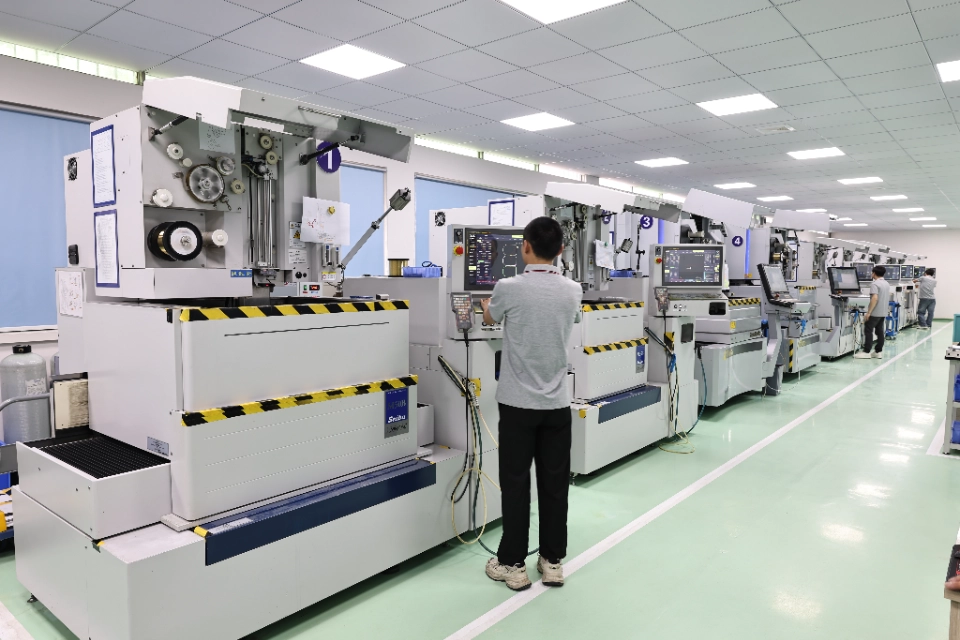
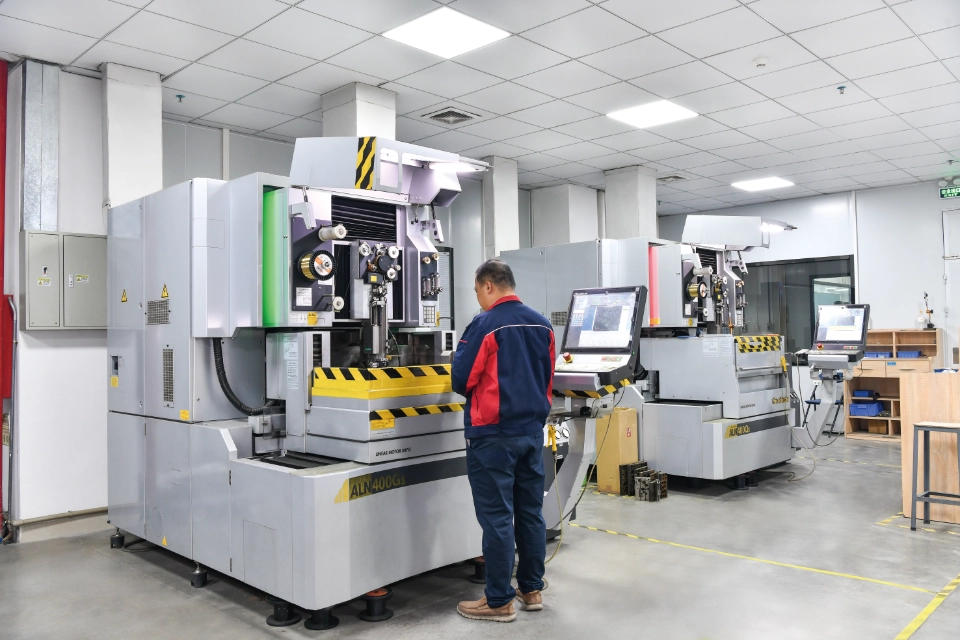


Our wire EDM workshop is equipped with multiple Seibu M50B CNC wire electrical discharge machines for the precision cutting of molds, inserts, punches, dies, electrodes, and conductive metal components.
Wire EDM uses a continuously fed metal wire as the electrode. Controlled electrical discharges remove material along the programmed cutting path while deionized water acts as the dielectric medium. Because the wire does not apply conventional mechanical cutting force to the workpiece, the process is suitable for hardened materials, thin sections, narrow slots, and complex profiles requiring stable dimensional control.
The equipment is operated within our factory and coordinated with CNC machining, heat treatment, grinding, EDM processing, and dimensional inspection.
Key Advantages:
- High-precision profile cutting
- Low mechanical cutting force
- Complex contour capability
- Stable repeat machining
- Multi-machine production capacity
Equipment and Production Capabilities
The Seibu M50B wire EDM machines are used to cut electrically conductive materials according to programmed two-dimensional and tapered profiles. A fine wire electrode travels through the workpiece while the CNC system controls the X, Y, U, and V axes.
This allows the equipment to process straight profiles as well as angled, tapered, and offset geometries. Automatic wire threading also supports continued machining when a program contains several independent openings or when the wire must be rethreaded during a longer cycle. Seibu’s wire EDM range includes automatic wire-feeding functions designed to support continuous precision processing.
Typical workpieces processed in this workshop include:
- Precision mold inserts and cores
- Punches and die components
- Connector mold components
- Tool-steel plates
- Carbide tooling components
- Narrow slots and small openings
- Complex internal and external contours
- Components requiring tapered cutting
- Precision parts after heat treatment
Wire EDM is particularly useful for features that are difficult to reach with conventional milling tools. It can produce closed internal profiles, narrow sections, sharp profile transitions, and detailed contours without introducing substantial cutting loads to the workpiece.
Multi-Machine Workshop Capacity
Multiple wire EDM machines are arranged in the same production area, allowing different components, cavities, cutting stages, and production batches to be processed in parallel.
Machine allocation is planned according to:
- Workpiece material and thickness
- Profile complexity
- Required dimensional tolerance
- Wire diameter and cutting strategy
- Surface-finish requirements
- Number of rough and finish cuts
- Order quantity and production schedule
For components requiring higher dimensional consistency or finer surfaces, the machining program may include one main cut followed by several trim cuts. Each pass uses controlled offsets and discharge settings to gradually refine the profile and reduce surface irregularities.
The workshop layout also allows operators to supervise several machines, prepare the next workpiece, check wire condition, and review machining progress while other programs continue running.
Role in Our Manufacturing Process
Wire EDM is integrated into our mold and precision-component manufacturing workflow rather than treated as a separate outsourced operation. Programming, workpiece preparation, positioning, cutting, cleaning, and inspection are coordinated by our internal production team.
A typical process may include:
- CNC rough machining of the workpiece
- Heat treatment when required
- Surface or cylindrical grinding
- Start-hole preparation
- Seibu wire EDM cutting
- Profile and dimensional inspection
- Polishing, fitting, or final assembly
For mold and die components, wire EDM is commonly arranged after heat treatment. This allows hardened tool steel or carbide parts to be cut to their final profile without relying on heavy mechanical cutting.
Keeping multiple Seibu M50B machines within the factory also helps the engineering, EDM, grinding, and quality teams coordinate directly. Wire offsets, taper settings, cutting allowances, fixture positions, and trim-cut conditions can be adjusted according to actual inspection results.
The Seibu M50B machines shown form part of our factory’s precision mold and component-production capability. Actual machining performance depends on the workpiece material, thickness, wire specification, profile geometry, cutting sequence, fixture condition, and drawing requirements.
Contact Information
-
 [email protected]
-
 +86 13342660375Telephone
-
 Address
No. 62, Jinghai East Road, Shatou Community, Chang' an Town, Dongguan City, Guangdong Province, China
Address
No. 62, Jinghai East Road, Shatou Community, Chang' an Town, Dongguan City, Guangdong Province, China
 Schedule a Home Visit
Leave us a Message
Have questions or need assistance? Get in touch with us, and we’ll be happy to help!


