 Tel: +86 13342660375
  E-mail:

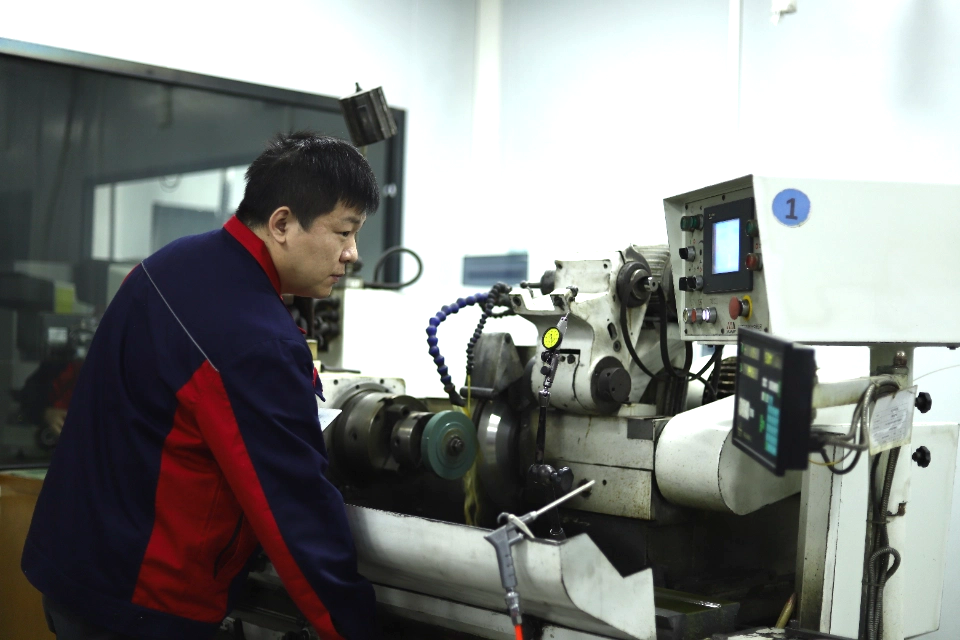


Our grinding workshop is equipped with internal and external cylindrical grinding machines for the precision finishing of shafts, sleeves, bushings, mold cores, guide components, and other rotationally symmetrical parts.
The equipment is used to control external diameters, internal bores, shoulders, end faces, and cylindrical profiles after turning, heat treatment, or preliminary machining. By grinding the workpiece around a defined rotational axis, the process supports close control of roundness, cylindricity, concentricity, and surface condition.
Key Advantages:
- Accurate diameter control
- Improved roundness
- Stable concentricity
- Fine surface finishing
- Suitable for hardened parts
Grinding Capabilities
Internal and external cylindrical grinding can be selected according to the geometry of each component.
External cylindrical grinding is mainly used for:
- Precision shafts
- Guide posts and guide pins
- Mold cores
- Bearing seats
- Stepped cylindrical parts
- Tooling and automation components
Internal cylindrical grinding is mainly used for:
- Precision sleeves
- Bushings
- Bearing bores
- Internal locating surfaces
- Cylindrical mold inserts
- Parts requiring controlled bore geometry
Depending on the component structure, the equipment can also support shoulder grinding, end-face grinding, taper grinding, and stepped-diameter finishing.
Typical inspection requirements include:
- Outside and inside diameter
- Roundness and cylindricity
- Coaxiality and concentricity
- Radial and axial runout
- Shoulder position
- Surface roughness
Role in Our Manufacturing Process
Cylindrical grinding is normally arranged after CNC turning or heat treatment. A controlled machining allowance is retained during the earlier process so that final dimensions and surface requirements can be achieved through grinding.
A typical workflow may include:
- Material preparation
- CNC turning
- Heat treatment when required
- Center-hole preparation
- Internal or external cylindrical grinding
- Runout and dimensional inspection
- Final cleaning and quality verification
Completing cylindrical grinding within our factory allows machining allowances, grinding parameters, locating datums, and inspection results to be coordinated directly between turning, grinding, and quality teams.
Contact Information
-
 [email protected]
-
 +86 13342660375Telephone
-
 Address
No. 62, Jinghai East Road, Shatou Community, Chang' an Town, Dongguan City, Guangdong Province, China
Address
No. 62, Jinghai East Road, Shatou Community, Chang' an Town, Dongguan City, Guangdong Province, China
 Schedule a Home Visit
Leave us a Message
Have questions or need assistance? Get in touch with us, and we’ll be happy to help!


