 Tel: +86 13342660375
  E-mail:

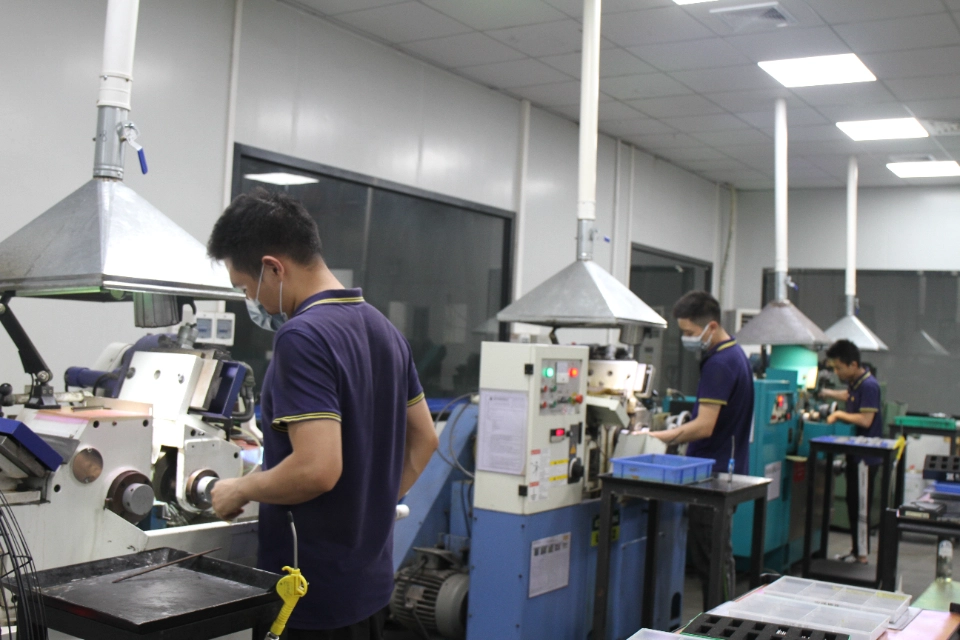


Our centerless grinding workshop is equipped with multiple machines for the precision processing of tungsten carbide rods, high-speed steel rods, guide pins, shafts, punches, and other long cylindrical components.
Centerless grinding does not require the workpiece to be held between centers or clamped in a conventional chuck. The part is supported between a grinding wheel, a regulating wheel, and a work-rest blade, allowing its outside diameter to be ground continuously.
This process is particularly suitable for long, slender, or high-volume round components requiring consistent diameter and surface quality.
Grinding Capabilities
The workshop supports centerless grinding of materials such as:
- Tungsten carbide
- High-speed steel
- Tool steel
- Stainless steel
- Hardened alloy steel
- Other grindable metal materials
Typical components include:
- Tungsten carbide rods
- High-speed steel rods
- Guide pins and guide posts
- Core pins
- Ejector pins
- Precision punches
- Small shafts
- Cylindrical tooling components
The process can be used to improve:
- Outside diameter accuracy
- Roundness
- Cylindricity
- Straightness
- Surface finish
- Diameter consistency across a batch
Through-feed grinding is generally suitable for straight cylindrical components without major shoulders. In-feed grinding may be used for parts with steps, profiles, or localized grinding areas.
Role in Our Manufacturing Process
Centerless grinding is integrated with material preparation, turning, heat treatment, end-face grinding, and dimensional inspection. It is often used to bring round stock or semi-finished components close to their final outside diameter before additional finishing or assembly.
A typical workflow may include:
- Raw rod or component preparation
- Heat treatment when required
- Initial straightness inspection
- Centerless rough grinding
- Centerless finish grinding
- End-face or profile processing
- Diameter, roundness, and surface inspection
The multi-machine arrangement enables different materials, component sizes, and production batches to be processed in parallel. In-house grinding also allows wheel condition, grinding allowance, feed settings, and inspection results to be adjusted according to each component’s material and tolerance requirements.
Contact Information
-
 [email protected]
-
 +86 13342660375Telephone
-
 Address
No. 62, Jinghai East Road, Shatou Community, Chang' an Town, Dongguan City, Guangdong Province, China
Address
No. 62, Jinghai East Road, Shatou Community, Chang' an Town, Dongguan City, Guangdong Province, China
 Schedule a Home Visit
Leave us a Message
Have questions or need assistance? Get in touch with us, and we’ll be happy to help!


