 Tel: +86 13342660375
  E-mail:

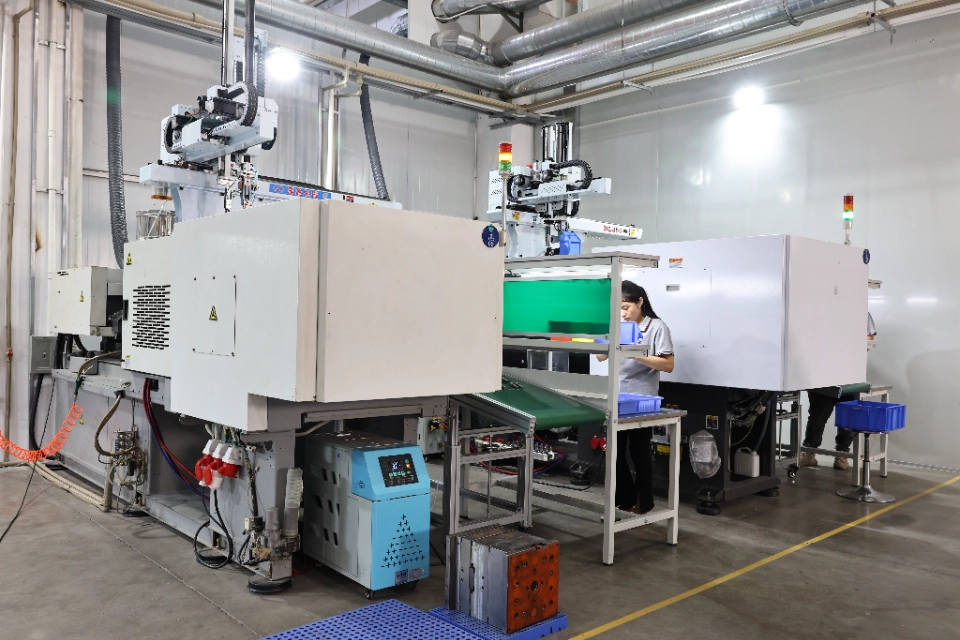


Our MIM injection molding workshop supports the in-house production of precision metal injection molded components. The area is equipped with multiple horizontal injection molding machines, automated take-out robots, material-handling systems, conveyors, and machine-side inspection stations.
During this stage, metal powder feedstock containing a controlled binder system is heated and injected into precision molds. The resulting molded parts, known as green parts, retain the required geometry before entering the debinding and sintering processes.
Production Capabilities
The workshop supports the molding of small, detailed, and geometrically complex metal components that may be difficult to manufacture efficiently through conventional machining alone.
Typical MIM applications include:
- Precision structural components
- Medical-related metal parts
- Electronic and connector components
- Automotive and industrial parts
- Small components with complex profiles
- Parts containing holes, ribs, grooves, and fine features
Operators monitor key molding conditions such as feedstock temperature, injection pressure, injection speed, holding time, mold temperature, cooling time, and demolding performance. These parameters are adjusted according to the feedstock formulation, mold structure, wall thickness, and dimensional requirements.
The top-entry robots remove molded green parts or runner systems after each cycle and transfer them to conveyors, trays, inspection stations, or collection areas. Automated handling helps protect green parts, which remain relatively fragile before debinding and sintering.
Role in Our MIM Process
MIM injection molding is the forming stage of our integrated metal injection molding workflow. A typical production sequence includes:
- Feedstock preparation
- Metal injection molding
- Green-part inspection
- Debinding
- Vacuum or controlled-atmosphere sintering
- Dimensional inspection
- Secondary finishing when required
Keeping injection molding, debinding, sintering, and inspection within the same factory enables closer coordination of mold dimensions, feedstock behavior, shrinkage compensation, thermal processing, and final part verification.
The workshop shown represents our in-house MIM injection molding capacity. Actual molding conditions are selected according to the metal feedstock, component geometry, mold design, dimensional requirements, and production quantity.
Contact Information
-
 [email protected]
-
 +86 13342660375Telephone
-
 Address
No. 62, Jinghai East Road, Shatou Community, Chang' an Town, Dongguan City, Guangdong Province, China
Address
No. 62, Jinghai East Road, Shatou Community, Chang' an Town, Dongguan City, Guangdong Province, China
 Schedule a Home Visit
Leave us a Message
Have questions or need assistance? Get in touch with us, and we’ll be happy to help!


