 Tel: +86 13342660375
  E-mail:

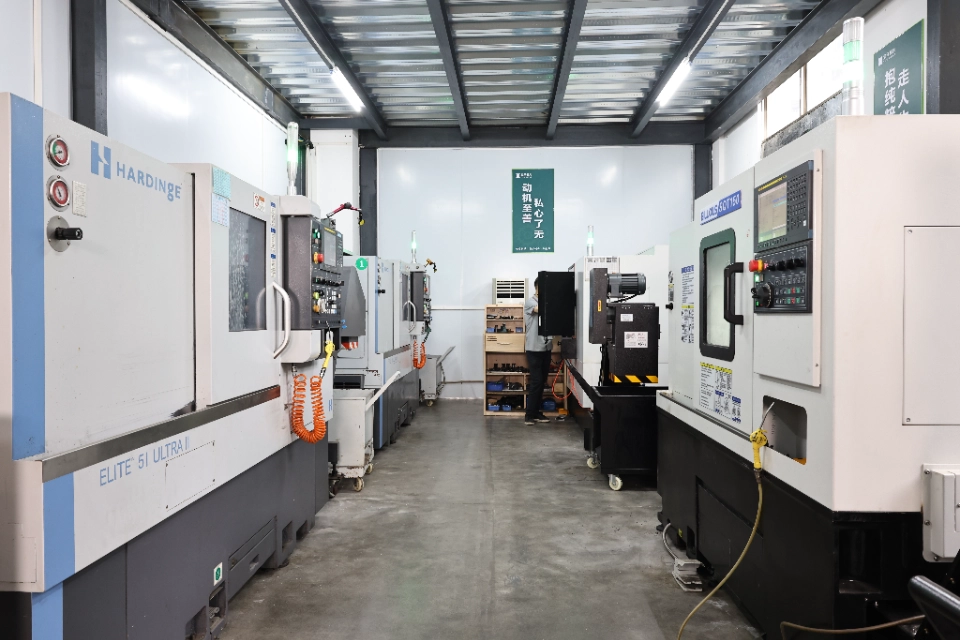


Our CNC turning workshop is equipped with multiple turning centers, including Hardinge ELITE 51 ULTRA II machines and an SQT150 turret-type CNC lathe. The equipment supports the in-house production of round, cylindrical, stepped, threaded, and rotationally symmetrical precision components.
These machines are integrated into our production workflow, covering CNC programming, tooling setup, turning, in-process measurement, cleaning, and final inspection. The multi-machine layout allows different materials, component sizes, and production batches to be processed in parallel.
The Hardinge ELITE 51 belongs to Hardinge’s precision CNC turning platform, while SQT150 machines typically use a turret configuration for sequential multi-tool machining.
CNC Turning Capabilities
The machines are mainly used to process cylindrical components around a controlled rotational axis. Multiple internal and external features can be completed within one machining cycle, helping maintain the positional relationship between diameters, bores, shoulders, grooves, and end faces.
Supported operations include:
- External diameter turning
- Internal boring
- Facing and step turning
- Grooving and undercutting
- Internal and external threading
- Drilling and center-hole machining
- Chamfering and profile turning
- Parting-off
- Rough and finish turning
Turret-type CNC lathes can carry several tools and index them according to the machining program, reducing manual tool changes between operations. The available SQT150 technical documentation describes a 12-position turret configuration for this machine class.
Typical Components
The CNC turning workshop supports the production of:
- Precision shafts
- Sleeves and bushings
- Guide pins and guide posts
- Mold cores and cylindrical inserts
- Ejector-related components
- Bearing seats
- Threaded connectors
- Flanges and spacers
- Automation equipment parts
- Small rotational components
Common materials include carbon steel, tool steel, stainless steel, aluminum, copper alloys, and other machinable metals specified by the component drawing.
Dimensional and Process Control
During production, operators monitor tool condition, workholding, spindle operation, machining offsets, and component dimensions. Parts may be checked at defined stages to confirm:
- Outside and inside diameter
- Overall length
- Shoulder position
- Groove width and depth
- Thread dimensions
- Concentricity
- Circular runout
- End-face condition
Measurement results are used to determine whether tool compensation or machining-parameter adjustments are required before the remaining batch is completed.
Role in Our Manufacturing Process
CNC turning is coordinated with grinding, milling, heat treatment, EDM, and dimensional inspection within our factory. A typical production route may include:
- Raw material preparation
- CNC programming and tooling setup
- Rough turning
- Internal and external feature machining
- Finish turning
- In-process dimensional inspection
- Heat treatment or grinding when required
- Final quality verification
Keeping CNC turning within our manufacturing facility allows engineering, production, and quality teams to coordinate machining allowances, locating datums, inspection requirements, and process adjustments directly.
The machines shown represent our factory’s CNC turning capacity for precision round components. Specific machining methods are selected according to part geometry, material, tolerance, surface requirements, workholding conditions, and production quantity.
Contact Information
-
 [email protected]
-
 +86 13342660375Telephone
-
 Address
No. 62, Jinghai East Road, Shatou Community, Chang' an Town, Dongguan City, Guangdong Province, China
Address
No. 62, Jinghai East Road, Shatou Community, Chang' an Town, Dongguan City, Guangdong Province, China
 Schedule a Home Visit
Leave us a Message
Have questions or need assistance? Get in touch with us, and we’ll be happy to help!


