 Tel: +86 13342660375
  E-mail:

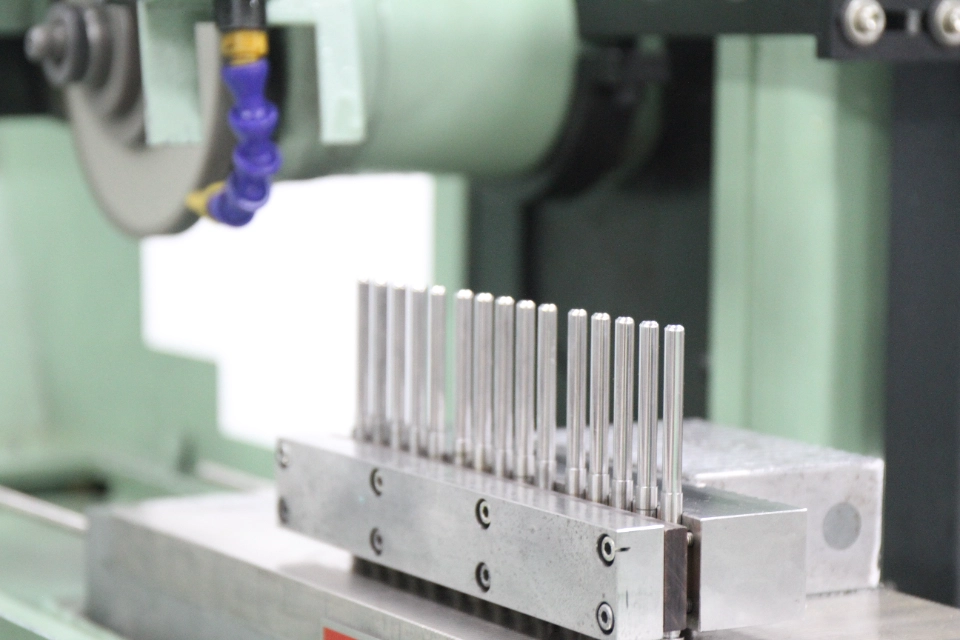


Our precision grinding workshop performs surface and end-face grinding for mold components, pins, inserts, plates, tooling parts, and cylindrical components requiring controlled length and consistent reference surfaces.
The image shows multiple slender cylindrical parts positioned vertically in a dedicated fixture while their upper end faces are ground to a uniform level. This setup is suitable for processing several components together when consistent height, flatness, and end-face quality are required.
Key Advantages:
- Consistent part height
- Accurate end-face control
- Stable flatness
- Multi-part processing
- Reliable datum preparation
Grinding Capabilities
Surface grinding removes a controlled amount of material from a flat surface using a rotating grinding wheel. The process is used to establish accurate reference planes and improve dimensional relationships between component surfaces.
For vertically positioned pins and cylindrical parts, end-face grinding can help control:
- Overall component length
- End-face flatness
- Parallelism between two ends
- Squareness to the part axis
- Height consistency across a batch
- Surface finish of locating faces
Typical components include:
- Mold pins
- Ejector pins
- Core pins
- Guide pins
- Precision punches
- Small shafts
- Cylindrical inserts
- Tooling and fixture components
The fixture helps maintain the workpieces in a stable and organized arrangement during grinding. Multiple parts can be checked and processed as one group, supporting repeatability across components produced for the same assembly or mold set.
Role in Our Manufacturing Process
Surface and end-face grinding may be performed after turning, heat treatment, cylindrical grinding, or rough cutting. The process provides accurate datum surfaces for subsequent assembly, fitting, measurement, or additional machining.
A typical workflow may include:
- Preliminary machining
- Heat treatment when required
- Outside-diameter grinding
- Fixture positioning
- Surface or end-face grinding
- Height and flatness inspection
- Final dimensional verification
Keeping this operation in-house allows the grinding team to coordinate part length, machining allowance, fixture layout, and inspection requirements according to the actual drawing and assembly conditions.
Contact Information
-
 [email protected]
-
 +86 13342660375Telephone
-
 Address
No. 62, Jinghai East Road, Shatou Community, Chang' an Town, Dongguan City, Guangdong Province, China
Address
No. 62, Jinghai East Road, Shatou Community, Chang' an Town, Dongguan City, Guangdong Province, China
 Schedule a Home Visit
Leave us a Message
Have questions or need assistance? Get in touch with us, and we’ll be happy to help!


