Tel: +86 13342660375
  E-mail:
 Home / Blog / Production News /
Table of Contents

- I. Material and Usage Acceptance
- II. Surface Treatment Acceptance
- III. Dimensional Accuracy Acceptance
- IV. Acceptance of Flow Channel and Water Transport Design
- V. Mold Cavity Quality Acceptance
- VI. Molding Trial and Product Inspection and Acceptance
-
FAQ
- Q: If a slight deviation in dimensions is found during mold acceptance, is it acceptable?
- Q: What are the consequences of substandard mold surface treatment?
- Q: What problems will occur in injection molding production if the runner design is unreasonable?
- Q: If a problem arises during the use of a mold after it has passed inspection, is the mold manufacturer responsible?
Contact Us
Updated 3 months ago
From Drawing Review To Final Delivery: Inside A Standardized Mold Production Process

YIZE
Established in 2007, Dongguan Yize Mold Co., Ltd. is a technology-driven, comprehensive manufacturing enterprise integrating the R&D, design, and fabrication of precision molds with injection molding services. Since its inception, Yize Mold has consistently adhered to the philosophy of “driving quality through technology and earning trust through quality,” successfully achieving a major strategic upgrade from precision mold manufacturing to the provision of PFA Teflon products and comprehensive solutions for precision structural components made of specialty engineering plastics.
In the industrial manufacturing sector, injection molds are considered the core tools for mass production of injection molded parts, widely used in numerous industries such as automotive, electronics, medical, and home appliances, holding a vital position as the “mother of industry.” The quality of the mold directly affects the precision, performance, and production efficiency of the injection molded products; therefore, the mold acceptance process is crucial. Dongguan Yize Mold Co., Ltd., as a professional enterprise in the industry, will now provide you with a detailed introduction to the key regulations for mold acceptance in injection mold factories.
I. Material and Usage Acceptance
The material and selection of the mold are fundamental to ensuring its performance and lifespan. Different steels possess unique physical and chemical properties, making them suitable for various production scenarios and product requirements. During acceptance testing, it is crucial to strictly distinguish the type of steel used to ensure it meets design requirements. Simultaneously, a professional hardness tester must be used to accurately measure the steel’s hardness; the hardness index must meet predetermined standards to guarantee sufficient wear resistance and compressive strength during long-term, high-intensity production, preventing premature mold damage or product quality defects due to material issues.
II. Surface Treatment Acceptance
The quality of the surface treatment inside the mold directly affects the appearance and demolding performance of the injection molded product. Common surface treatment methods, such as polishing, aim to achieve a certain smoothness on the inner surface of the mold, reduce surface defects and friction, and ensure smooth demolding. During acceptance, it is necessary to carefully check whether the surface treatment inside the mold is uniform and smooth, and whether there are any scratches, burrs, or other defects, to ensure that the surface quality of the injection molded product meets high standards.
III. Dimensional Accuracy Acceptance
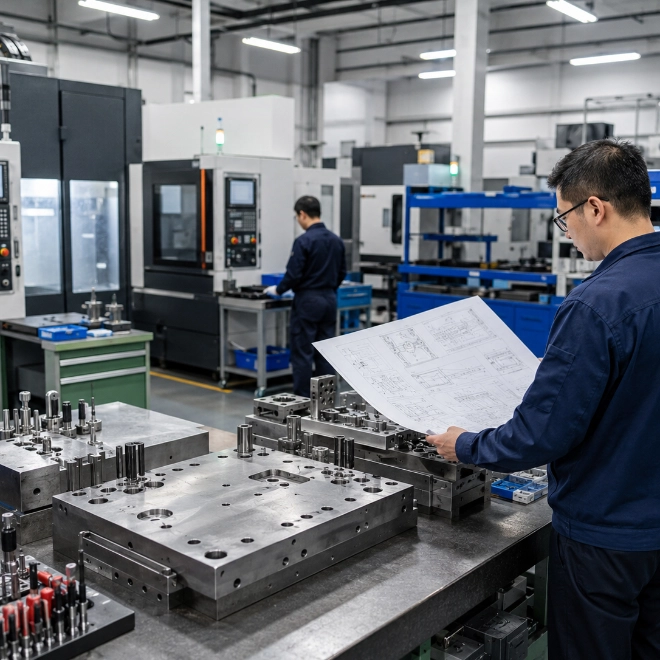
The dimensional accuracy of the mold is a key factor determining the dimensional accuracy of injection-molded products. During the acceptance process, high-precision measuring tools, such as coordinate measuring machines, must be used to rigorously inspect all critical dimensions of the mold to ensure a high degree of conformity with the dimensional tolerances of the design drawings. Only with accurate mold dimensions can injection-molded products with stable dimensions and meeting assembly requirements be produced, avoiding situations where dimensional deviations lead to unusable products or affect the overall performance of the product.
IV. Acceptance of Flow Channel and Water Transport Design
Proper runner and water cooling system design is crucial for the injection molding process. Runner design directly affects the flow and filling effect of molten plastic within the mold. A well-designed runner layout ensures uniform and rapid filling of the mold cavity, reducing internal stress in the product and preventing defects such as short runs and burning. Water cooling system design relates to mold cooling efficiency. An effective cooling system can quickly reduce mold temperature, shorten the molding cycle, improve production efficiency, and ensure product dimensional stability. During acceptance testing, a comprehensive evaluation of the runner and water cooling system design is necessary to check whether they meet process requirements and ensure smooth injection molding.
V. Mold Cavity Quality Acceptance
The mold cavity is the direct space in which injection-molded products are formed, and its quality directly determines the product’s appearance and internal quality. During acceptance testing, the inside of the mold cavity must be carefully inspected for scratches, dents, corrosion, and other defects. These defects not only affect the product’s aesthetic appearance but may also lead to problems such as surface roughness and reduced strength. Therefore, it is essential to ensure good surface quality of the mold cavity to guarantee the production of high-quality injection-molded products.
VI. Molding Trial and Product Inspection and Acceptance
The trial molding process is a crucial step in mold acceptance, involving actual injection molding production to comprehensively test the mold’s performance and product quality. During the trial molding, the dimensions of the molded part must be precisely measured to ensure they meet design requirements; trial assembly operations must be performed to verify the assembly accuracy and fit between the various components; the mechanical properties and durability of the product must be evaluated through tests such as throwing, pulling, and twisting; and the product’s appearance must be meticulously inspected for defects such as color differences, bubbles, and weld lines. Only when the molded part meets all the requirements in all testing indicators can the mold be considered accepted.
FAQ
Q: If a slight deviation in dimensions is found during mold acceptance, is it acceptable?
A: It depends on whether the dimensional deviation is within the tolerance range specified in the design drawings. If the deviation is within the allowable tolerance range, it is usually acceptable; however, if it exceeds the tolerance range, it may affect the assembly and performance of the product, requiring the mold factory to make adjustments and repairs until the dimensions meet the requirements.
Q: What are the consequences of substandard mold surface treatment?
A: Inadequate mold surface treatment can lead to defects on the surface of injection molded products, such as scratches and pitting, affecting the product’s appearance quality. Furthermore, an uneven mold surface increases friction between the product and the mold, making demolding difficult and potentially damaging the product or the mold itself.
Q: What problems will occur in injection molding production if the runner design is unreasonable?
A: An improper runner design can lead to uneven flow of molten plastic within the mold, resulting in localized underfilling or overfilling, which can cause defects such as material shortages, burning, and bubbles. Furthermore, an improper runner design can increase injection pressure and molding cycle time, reducing production efficiency and increasing production costs.
Q: If a problem arises during the use of a mold after it has passed inspection, is the mold manufacturer responsible?
A: Generally, if a problem arises during normal use of the mold, and the problem is due to a quality defect or unreasonable design of the mold itself, the mold manufacturer should bear the corresponding responsibility and be responsible for repairing or replacing the mold. However, if the problem is caused by improper use, operational errors, or force majeure,
Written by
YIZE
YIZEMOULD
Established in 2007, Dongguan Yize Mold Co., Ltd. is a technology-driven, comprehensive manufacturing enterprise integrating the R&D, design, and fabrication of precision molds with injection molding services. Since its inception, Yize Mold has consistently adhered to the philosophy of “driving quality through technology and earning trust through quality,” successfully achieving a major strategic upgrade from precision mold manufacturing to the provision of PFA Teflon products and comprehensive solutions for precision structural components made of specialty engineering plastics.
-
Share
-

-

-

Recent Articles